
Markets Regulate Best
Post #1513

People often claim that economic regulation is required activity from the government, because otherwise the “greedy capitalists” will “exploit the workers” and work them into the ground or put them into danger and allow them to be injured or killed in the chase for “the almighty dollar.” But this rhetoric is not grounded in evidence.
A similar situation involves government mandating things like measles vaccines, even though, by the 1960s (before vaccines), measles had already become a safer disease than seasonal flu. The TV show, The Brady Bunch, had an episode when the kids casually get measles — permanently enshrining the truth of the matter: It is not a big deal.
When the Occupational Safety and Health Administration (OSHA) began in 1970, the purported reason for it was because, if you do not regulate job safety, more people die. But let’s check the assumption to find out if it is grounded in the evidence, or if it is just a “notion” that people latched onto, even for non-logical and self-serving reasons.
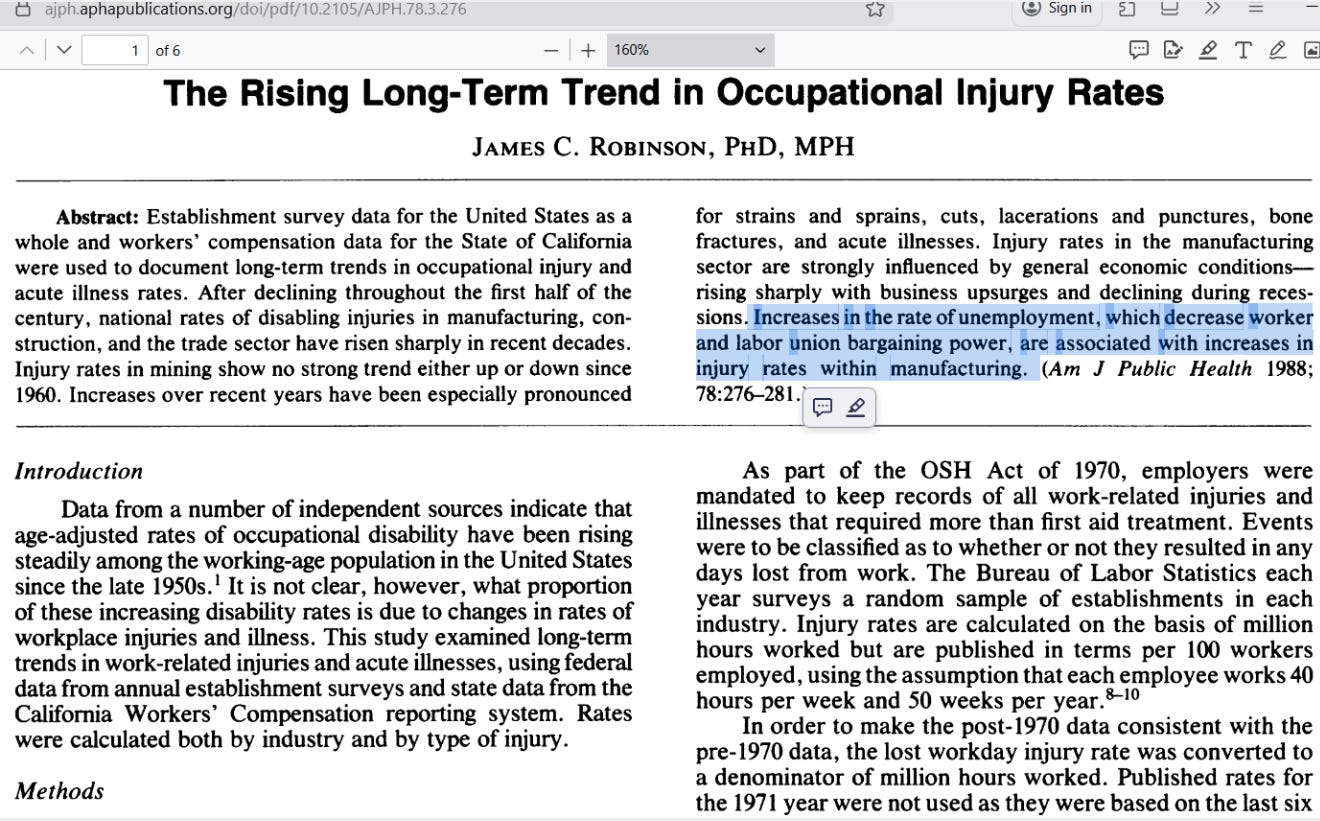
This article published in the American Journal of Public Health cite how it was that, before the federal government was inserting itself into the business affairs of job creators — forcing them to pay for the compliance with safety regulations, instead of using the money to grow their business — on-the-job injury rates were falling.
The highlighted part reveals something non-obvious: anything that hurts business prospects (such as onerous safety regulations) can lead to unemployment, which then leads to increased injuries for the remaining people who are employed. This means that the best way to cut injury rates might be to get out of the way of businesses.
Here is the timeline of on-the-job injury rates with orange markings added to show the year when the federal government began to interfere with business owners in order to force them into costly compliance with federal safety regulations (orange marks added):
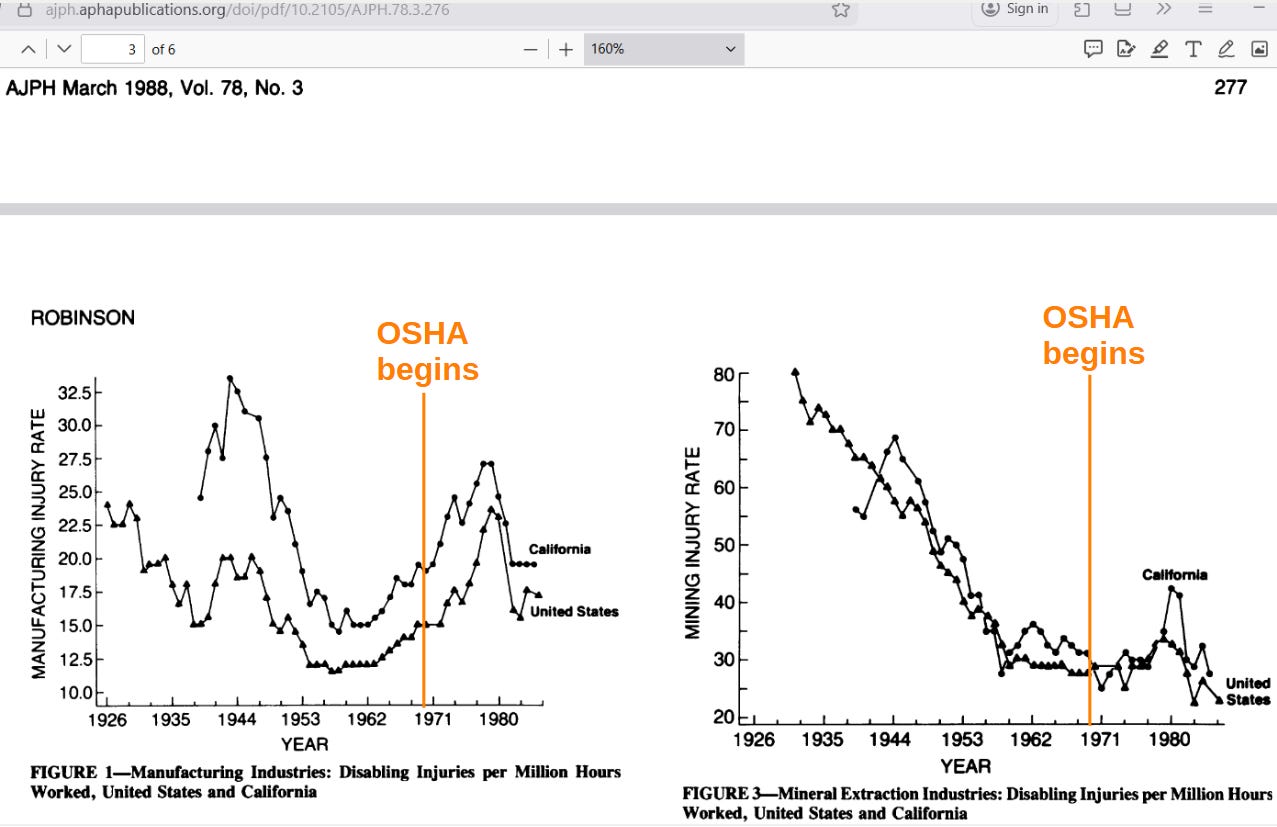
When the timeline of on-the-job injury rates is split from the time before broad federal safety regulation to the time after, it is easy to tell that jobs got much more safe, and much more quickly, in the absence of federal safety regulations. In most cases, jobs became more than twice as safe prior to OSHA.
But jobs did not become twice as safe “after” OSHA (OSHA was not as good as unregulated capitalism was, in bringing job injury rates down). Here is another example:
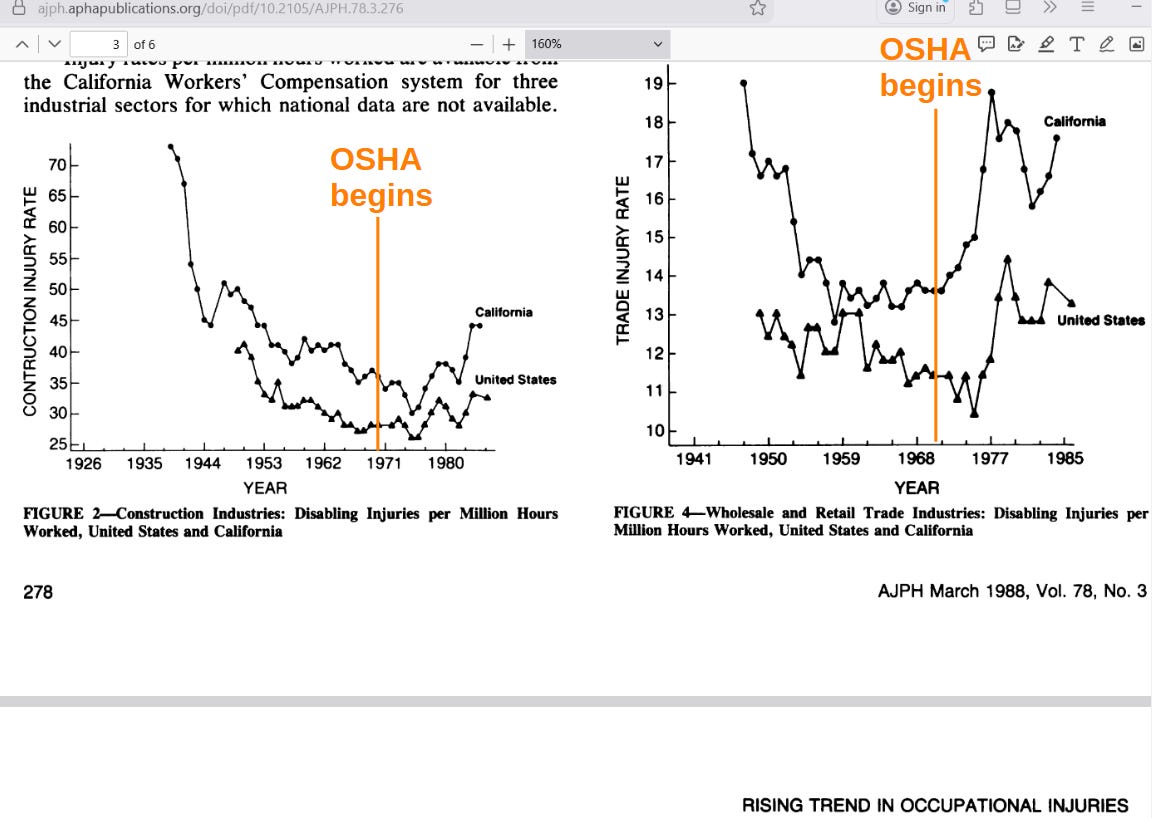
Once again, the free market was bringing down job injury rates relatively quickly prior to OSHA, but not after OSHA. The evidence suggests that markets “self-correct” and that there is no pressing need for government regulation of economic affairs. Markets, if left alone, will regulate themselves better than any government panel can.
Reference
[Less regulation produces outcomes that are better than more regulation produces] — https://ajph.aphapublications.org/doi/pdf/10.2105/AJPH.78.3.276